
Smarter regulation, here and now I Podcast transcript
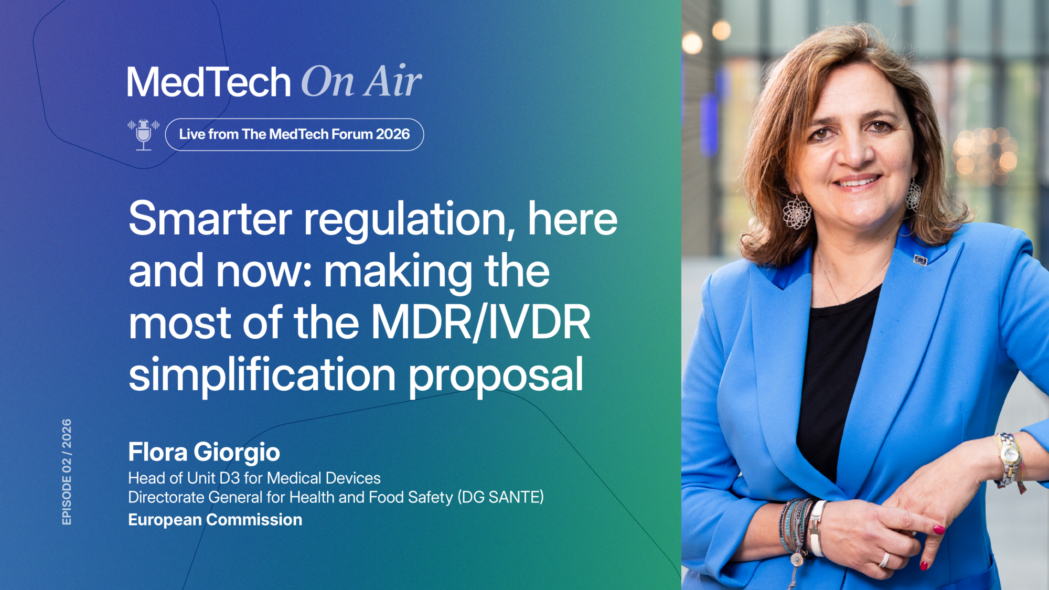
This is a transcript of the MedTech ON AIR podcast episode “Smarter regulation, here and now: making the most of the MDR/IVDR simplification proposal“. This transcript was generated automatically. Its accuracy may vary. You can listen to the episode on SoundCloud or Spotify.
Davidson Leite
Welcome to MedTech ON AIR, MedTech Europe’s podcast on the issues shaping the future of medical technology. I’m Davidson Leite, Director of Communications at MedTech Europe, and this episode is part of a series of interviews we recorded on the ground at the MedTech Forum 2026. If the background sounds a little livelier than our usual studio setup, now you know why. In this episode, I’m joined by Flora Giorgio. Flora is the Head of Unit for Medical Devices at the European Commission’s DG SANTE, and we found a quietish corner to sit down and talk through some of the most consequential files in Medtech policy right now. The revision of the Medical Devices Regulation and the In Vitro Diagnostics Regulation, Implementing Acts, UDAMED, and the European Commission’s pilot to support the development of breakthrough medical devices. It’s A packed conversation. So let’s get into it.
So for this session, I have the pleasure of sitting with Flora Giorgio. Flora, thank you so much for making the time to speak with us. Could I please ask you to introduce yourself to our listeners?
Flora Giorgio
Thank you, Dave. Yeah, it is a pleasure. My name is Flora, Flora Giorgio, working in the European Commission in DG Sante, the unit D3, which is actually responsible for this famous and famous Commission proposal and the revision of the regulatory framework and several other related activities that are, I guess, very dear to you today.
Davidson Leite
So your unit is the one driving the work on the revision of the medical device regulation, in vitro diagnostic regulation. You’ve been keeping us busy.
Flora Giorgio
Indeed, because also it’s not only about thinking about the future, but we also implement the present and we also deal on a daily basis with what works and what works less good in this framework. And that’s where the whole input come from as well.
Davidson Leite
Okay, excellent. So I guess that this must have brought a lot of attention to your sessions. You spoke in two sessions yesterday and I know you have another one later today. Can you tell us a little bit about the sessions?
Flora Giorgio
There were actually 3 sessions. I was taking them as a surprise invitation on one of, I have to say, the project. pretty familiar and close to which is it was a UDAMED session to promote the mandatory use of UDAMED in 15 days from today. So stay tuned very soon. And that’s one of the points I really tried also yesterday in the two morning session to underline. And I think that’s what also the message I would like to give here today. Of course, the proposal is a key step for the future for reshuffling a bit, well let’s say adjusting A framework which had high ambitions but have also showed important challenge. So we really aim with this proposal to fix and adjust what we need to do based as I said from a lot of input, calls and experience in the unit itself. But it’s also we have a lot that we already, everybody can do today to improve the current framework. And UDAMED is one of those deliverables because it’s voluntary now, but as of 15 days from today with some transitional periods, which I leave you the details, but there is a lot of information available on our info session website. EUDAMED will be mandatory, and this is a major opportunity for everybody to have more transparency, accessibility of information and use the data, and really also implement one of the objectives of the proposal.
Davidson Leite
So it’s a two-way street, right? So it’s important for the commission to have the data from the industry to make more informed decisions and be able to propose such actions, such as the revision, but also for the industry itself.
Flora Giorgio
For the industry, for notified bodies, for patients and professionals, somebody called it the source of truth. But it is a landmark, it’s not. Some people call it a database. It’s not a small detail. It’s an IT system that underpins the regulatory framework, so, and it’s a major simplification if it’s used, and that’s where one call really to the industry and to all stakeholders to really use it and start using it now. Every new IT system has its hiccups, so bear with us. It won’t be perfect from day one. We have all had exactly the pain of IT, ambitious IT infrastructure and project. But yeah, and what I was a bit surprised also in the corridor talks that not everybody is aware this is coming.
Davidson Leite
Guys, you need to catch up. This is important.
Flora Giorgio
We had quite a significant increase of registrations in the last three months, but we need more.
Davidson Leite
Yeah, I think people are just leaving it for the last minute, which is a bad idea. Florida joined the session yesterday because you need to start doing this now. It’s important.
Flora Giorgio
Yeah. And, you know, EUDAMED is one, but another thing that we are pretty proud of, I have to say, as a unit and as a system. With the, also with the Member States, we have adopted an act which sets out some timelines for the conformity assessment and the interaction with the notified body. So I think this is another thing. Again, there will be some transitional provision, but this is…
Davidson Leite
So this is the implementing regulation that came out last week, right?
Flora Giorgio
This is another building blocks. We are really bringing, this is one, there is the breakthrough technology, there is a pilot launched just last week again. So very productive and intense weeks in mind and even more in front of us. So really, don’t wait the end and don’t just say, well, okay, let’s see, in a year, two years we get the proposal, hopefully earlier.
Davidson Leite
Yeah, fingers crossed.
Flora Giorgio
But use what is already available today, and we are committed to continue in this, let’s say, direction of providing a framework which is more agile, predictable and proportionate. And what we can do already now, we are doing so. Use what we already do because that’s really what we are all, this sense of urgency.
Davidson Leite
Yeah, and I think that is a little bit on us as well. And here, because I’m in the communications team, so I’m not the one following all the regulatory developments, but we had to communicate this to the members. And that’s why I know the breakthrough pilot was out, then the implementing regulation. But as you said, I think that the industry also needs to be aware of this, and talk about it and act on it because you’re trying to make it work. So we are on the other end. And then together with notified bodies, with health care professionals and et cetera, it’s the full spectrum of care.
Flora Giorgio
And I really think awareness and communication, it’s really important because we can develop a very nice, you know, we had another clinical guidance on giving transparency on what are the different national requirements for certain clinical study. Not great that we have seen differences, but at least you have the transparency. Let’s promote those things because there’s a lot of work behind, and they need to reach the real beneficiary, the ones that have to apply. And that’s not an easy task, especially because we have, as you know, even better than I, the variety of stakeholders and even in the company world, there are the big established companies that have a full regulatory affairs department, and there are the little ones that actually have five people in total and they…
Davidson Leite
For SMEs, 90% of our industry composed of SMEs and for them it’s way more challenging, right?
Flora Giorgio
And I think there is also, that’s what we also try to implement in the proposal. There are SMEs and SMEs because a micro and a small are different than a medium. And I think that’s also something we are trying to reflect in the proposal. It’s really not one-size-fits-all. Yesterday, we heard the variety of devices, the number of devices, and the number of actors playing in this field. And one-size-fits-all solution doesn’t work. It doesn’t work. And even, you know, we have risk-based approach, sure, great, but even there, there is granularity and stratification that we need to reflect better to ensure that the system performs as it was meant to do.
Davidson Leite
And I guess that was the focus of one of the main sessions. I saw you speaking at the plenary, which was future proofing MDR and IVDR, build a competitive and trusted EU system. Then there was also one on the breakthrough medical devices in the EU, from research to faster patient access. And I think that this is the one point that everyone agrees, right? We need to bring life-saving technology faster to patients. So that’s the unifying point.
Flora Giorgio
I hope there are also a few more. I am hoping the proposal
Davidson Leite
Of course, I’ve got not the only one.
Flora Giorgio
I hope there are more.
Davidson Leite
No, it’s not the only one. You’re right, you’re right. And then I saw that there was also one on CE marking and global access. So that’s the one that you’re speaking at today, right? So across these three discussions, is cooperation the word of order? What do you think that is really the red thread?
Flora Giorgio
It is a cooperation opportunity and looking ahead. I think we have to look, and this is another call I’ve made yesterday and I will repeat, well, maybe today as well, look at this proposal in a holistic way in the bigger picture. What I’ve often confronted, but this article, you delete this, and this is the article people focus on because, you know, that’s the one related to their specific activity. That doesn’t work. This proposal is a holistic proposal. We remove certain things, we add some other things there, and we add things in a more horizontal, structural way, cooperation mechanism. I mean, we have, I know that there is always this also concern from the industry. Oliver last year said we want one captain on the ship. We try to go in that direction, but in a pragmatic way on what we have in the current framework. But I think you need to look at the bigger picture, the different parts, and even on a broader dimension, because the proposal also has some elements. You mentioned the international dimension that I will talk about later today, but also the interplay with other legislation. We have this proposal of also move, you know, in integrating the MDR, the AI, basically, the AI act and make this famous move from the more horizontal approach to a sectoral approach, which by the way, the digital omnibus has, well, the AI omnibus now called has confirmed because they have now moved one sector and acknowledged that one, the Commission also acknowledged that maybe, a tailored approach is needed and that’s what we aim at achieving with the proposal, safeguarding the essential requirement, horizontal requirement of the AI Act. We just want to make sure that they are applied in one frame.
Davidson Leite
One single set of rules.
Flora Giorgio
One single set of rules, process and procedure more streamlined. It’s really in the optic and in the objective of simplification, which this proposal is all about. It’s not lowering rules, but it’s really make them more proportionate.
Davidson Leite
And this is key because I think that especially with this AI Act discussion, people thought that there would be a removal of requirements or we are not actually assessing this in medtech. On the contrary, it is already one of the most regulated industries, and the idea is to incorporate all of that, but it’s just one rule book.
Flora Giorgio
One rule book, one, you know, competence. It’s a simplification because we, and you know, from the Commission perspective, we of course and the AI Act is a landmark because Europe is the first jurisdiction, is one of the more advanced that actually is regulating this technology, which is a real, is the new Internet. The same revolution that a few decades ago we got with the Internet will get it with the AI. So we cannot just think that and put our, you know, head under the carpet, the table, we’re saying. So that’s not the idea. The idea is exactly the contrary. Living for a sector like ours where actually any delay, duplication, unclarity, and even in the decision-making process, having two authorities deciding who does what, we cannot afford it. It’s about patient safety. It’s about patient having risks, and I have to say I was a bit concerned by the standard some stakeholders in your professional patient took on that. I think clearly the proposal needs to be more explained and understood what is the rationale behind, but we are working in that direction and it goes for this provision. Several other provision it requires an understanding where we come from and I hope with this clarity and that’s why, for me dialogue and continuous exchange which we had before and we will continue to have even though of course in the institutional framework is key actually.
Davidson Leite
And I think that you touched upon a super important point, which is just communicating this more and more clearly because it’s in no one’s interest to have a system that does not put safety front and center. And for me, it’s really a triangle and all three points depend on each other. So you have patient safety and access, innovation, and then efficiency, right? So if it’s simple and efficient, we can innovate more. The moment that we innovate more, we actually can deliver things that are safer, faster for patients. And they are the ones in the center of this triangle.
Flora Giorgio
Absolutely. And it’s really what we have put at the core of this proposal. And yes, it’s presented as, but this is a simplification proposal. How does simplification cannot compromise patient safety? And while I looked up actually, I did my homework and looked at the definition of what is a simplification. Some refer to this as this is deregulation. No, it’s not the deregulation. It’s really making existing rules less burdensome. We have a lot of paperwork in this current framework. A lot of time is spent by the extremely important resources and notified bodies, authorities in checking that we have the necessary paper to justify something. No, we want to make sure that the devices are safe. And of course, you need the proof of the safety. But that’s where we need to find a more streamlined process.
Davidson Leite
So if I hear you well, for me, it’s not about deregulation, it’s about smarter regulation. It’s just how do we keep regulation in place, but we do it better.
Flora Giorgio
Yes, I mean, what simplification is all about, taking out the unnecessary administrative burden, streamline process and procedure, and that’s where you see all the provision we put together for the change the way we support Member States cooperation, because that’s another essential element. It’s not only, I have to say, a manufacturer, it’s really the system as such. And how we make sure that the national competent authority can be supported in a more efficient and manner. So that’s why we ask the agency to help on that, and as well by strengthening the EU scientific basis that the system needs. And that’s where also we see a major opportunity in the expert panel. All things that we, the current framework had foreseen, but is not used in the way that should have been used for a number of reasons that, you know, the past is the past. Let’s really make sure that the future is different. It’s better.
Davidson Leite
Yeah, that’s the most important thing. You propose a regulation, you learn from the reality, from real challenges, and you make it better. So that’s the goal of every revision.
Flora Giorgio
And that’s what we had to learn also painfully in the last six months, because as you know, we were asked quite quickly to come up with a proposal, but what we really invested, and I never thank enough the team, we really invested in listening. I mean, we had, I always have these slides with a lot of little bubbles. All the different stakeholders. But we had, public consultation. We had call for evidence, twice public consultation. We had a number of targeted discussion with different stakeholders from hospitals, patients, of course, industry has always been very vocal for the reason, notified bodies. Everybody, I think we have, again, and in different format. Even we try to reach out as much as is possible to very small micro enterprise. We have been traveling around Europe, me and colleagues and our senior management to really, and our Commissioner as well, to talk.
Davidson Leite
Yeah.
Flora Giorgio
And here firsthand. And that’s, and then as I said, and then we have 10 years of experience in implementing this framework. And that’s where every single provision is not coming out of the Commission office and somebody clever enough that thought this is a good idea, no? It tries to respond to a problem that we have been exposed to. Then maybe, yeah, let’s see, you know, now we need to make sure that this problem is addressed, but every single provision is based on facts and learnings.
Davidson Leite
And this is really important. What I particularly love is what you said about micro businesses as well, the small companies, because when people think of the revision, they think that this is something to please big companies. I mean, big companies, of course, they want the revision as well, but they can adapt. But for small companies, many of the points of the revision are actually existential. So it’s actually going to allow them to continue operating in Europe and bringing the medical technology that we need.
Flora Giorgio
Yeah, indeed. And hospitals is a point I know industry may not be super happy about, but also for the hospital, university hospital, center of excellence that does some devices in-house. Tricky point, but I think we have to be fair. There are things that maybe the current system had in mind and didn’t work. Then let’s see how we can make it work better.
Davidson Leite
And that’s okay, right? I think that even the industry has to acknowledge that there will always be a point of tension. You cannot make everyone happy, but we need to find a good compromise, something that works and that is more efficient for everyone across the board.
Flora Giorgio
That’s my challenge. We cannot make everybody happy, and I think a good regulatory framework cannot. But everybody needs to be a bit happy and a bit unhappy, and that’s maybe show that maybe we found the right balance.
Davidson Leite
A big challenge. Good luck with that one. I know it’s not an easy one. And you know, you’ve been speaking with industry patients, notified bodies, hospitals. What I always ask people from the industry is what they believe to be the biggest challenge and the biggest opportunity. So you’re not from the industry, but you know everyone and beyond across the healthcare landscape. In your perspective, what is the biggest opportunity shaping the medtech sector?
Flora Giorgio
I think it’s for me, and maybe I am slightly biased, I think this proposal is a major opportunity because it tries to bring this proportionality, predictability and harmonisation, which currently not the way we were hoping to have. And it’s also even a bigger, in the bigger picture, it’s even as a bigger consequence, because I think it’s about how Europe can respond to a challenge. And I think Europe is in a challenging time. The world is in a challenging time. And I think if we can show that we can address the problem in a proportionate and agile manner, I think we’ll give the signal that the industry needs that I keep investing in Europe. I mentioned the patent. I mean, we want, you know, we want that innovation is not only patent and we have great brains, but we want to have the technology stays and give the signal to the industry, to the investors that Europe is the place to be. And yesterday, was it yesterday or two days ago, we had an agreement on the Critical Medicines Act, not medtech, but this is another example on how when you want, you can find an agreement. And we need to look a bit at the bigger picture and risk-benefit. Yes, let’s not engage in an endless negotiation on making this wording perfect for everybody because that’s what happened in the past and we don’t have the luxury of the time and we don’t, not only for the patient safety because I think that’s our priority, but also for the signal to give to the sector and to the world, I think.
Davidson Leite
That’s super powerful. And I think you started touching upon this, but my final question is, thinking of the Forum’s participants and beyond, if you could ask our industry to do one thing, what would it be? What is your call to action?
Flora Giorgio
Use what we are putting in place already now, because we want to improve from day one and be proportionate as well. Don’t ask, you know, be proportionate. I think, we say in Italian, we say a good person will understand the message. I think be proportionate. Not everybody can be happy, but we need to go in a certain direction, and we believe our proposal goes in that direction.
Davidson Leite
Excellent. That’s perfect. Thanks so much, Flora. This is super insightful.
Flora Giorgio
Thanks a lot. It was very pleasant as usual. Thank you.
Davidson Leite
Likewise. Thank you.
That’s a wrap on what I think was one of the most wide-ranging conversations we’ve ever had on MedTech ON AIR. A huge thank you to Flora for taking the time, especially in the middle of a packed day at the MedTech Forum. If today’s discussion got you thinking about the MDR and IVDR revision, I would encourage you to go deeper. MedTech Europe has published its full position on the revision, setting out what we believe needs to change and why. You can find it on our website at medtecheurope.org. And if you found this episode on social media, the link is in the comments. It’s the most comprehensive statement we’ve put out on this topic, and it’s worth a read whether you are in industry, in policy, or somewhere in between. And stay tuned. There are more interviews from the MedTech Forum coming your way. Until next time, thanks for listening.
Posted on 06.08.2026
 Discover the MedTech ON AIR podcast