


Back in the saddle after spine surgery

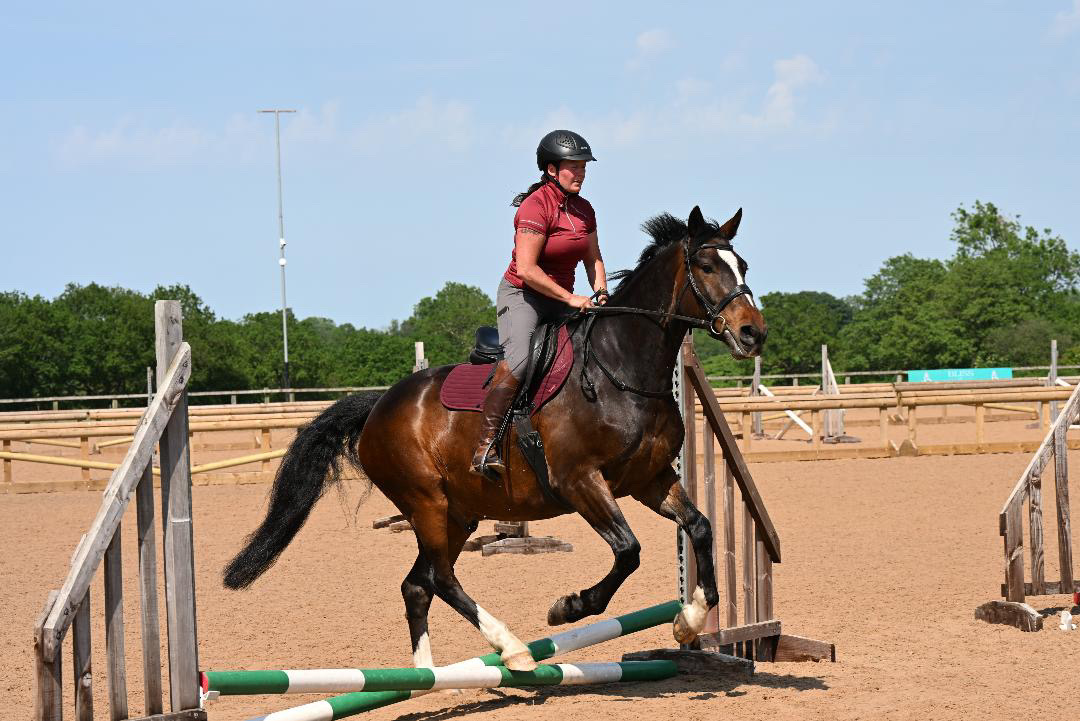
When Andrea Swift started having debilitating back and leg pain, her livelihood working with horses was at risk. A scan that revealed a herniated disc was the first step towards getting her life back. Below she shares her story on World Spine Day.
“All my life I’ve had a very physical job working with and riding horses. I had some minor lower back pain for about 10 years that I just shrugged off,” Andrea tells MedTech Views. “Then about two years ago, the pain started going down my leg and I was losing sensation in my toes.”
She tried multiple therapies including acupuncture, physiotherapy and shock wave therapy, but nothing worked and the pain kept getting worse. Eventually, her doctor put her on painkillers, but they didn’t work either. “The pain was debilitating and it took a lot of my independence away,” Andrea recalls. “I was in tears getting out of bed in the morning and it took me an hour to get going every day. I’d say on a scale of one to ten, the pain was 100.”
Finding the cause
Finally, she had a magnetic resonance imaging (MRI) scan, which took images of her spine and showed that she had a herniated disc. This meant that one of the soft, jelly-like cushions between the bones of her spine (vertebrae) had pushed out through a tear in the tough outer layer that usually encases the vertebrae and stabilises the spine.
“The doctor said that the disc herniation was quite bad and I would need surgery. At that point, I didn’t care anymore. I just wanted the pain to go,” says Andrea. “I had microdiscectomy surgery to remove the part of the disc that was sticking out and the pain down my leg went away immediately.”
Microdiscectomy explained
Microdiscectomy is designed to alleviate nerve pain by removing the portion of the disc that has leaked out through the tear, but it doesn’t heal or structurally repair it. It’s intentionally conservative to preserve as much of the natural shock-absorber as possible. The tear can’t be easily closed with stitches due to the structure of the outer layer, so surgeons leave it to re-seal with scar tissue.
Recovery and resilience
“While I was recovering, I couldn’t work or ride horses, and I had to be strict about not bending, lifting and twisting for the first four weeks. I was horse riding again after eight weeks and then I went back to work about three months following the surgery,” Andrea notes. “For the first year, I was still very careful. After that, I felt it was time to work on getting stronger, especially in my core, so I joined a gym. It was going well until I bent over one day and felt the same nerve pain that I hadn’t had since my surgery.”
Andrea immediately went back for an MRI and discovered that more of the remaining disc had leaked out. “My doctor told me that this can happen and it often resolves on its own,” she says. “Fortunately, the pain is nowhere near as bad as before. Aside from some niggles in my glute, I’m fine. I’m managing it myself by avoiding high-impact moves, watching my nutrition with an anti-inflammatory diet, drinking plenty of water and continuing to do core-strengthening exercise. I’m still happy that I had the surgery because it took the pain away and gave me my life back.”